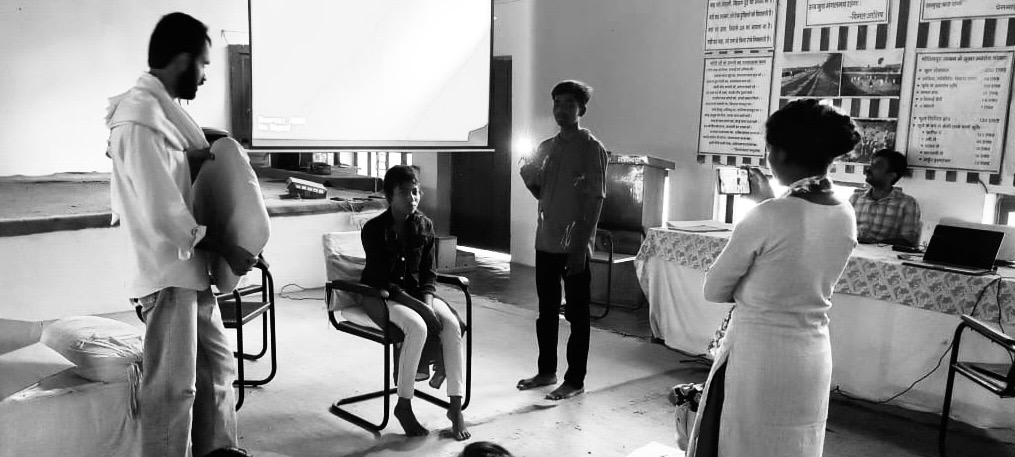
When I visited Banwasi Ashram to conduct my theatre in education [TIE] workshop, I had no idea it would transform not just the students but me as well. There were around thirty students, and the workshop was planned for seven days.
On the first day, when I entered the classroom, I saw fear in their eyes. They were silent and hesitant. I asked them to introduce themselves in Hindi or in their native language but to my surprise, they couldn’t utter even a single word. That moment struck me deeply. I thought to myself, What has happened to their confidence? Why are they so afraid to speak?
Later I came to know that before me, around fifty workshops had already been conducted there. But in all those, the teachers spoke and the students only listened without understanding much. There was no interaction, no joy. So I decided to break that pattern.
On the very first day, I played music and said, “Let’s stand up and jump! Let’s dance!” Some of them tried shyly, while others stood still, unsure of what to do. But that was our beginning. From that moment, the real transformation started.
Our classes began each morning at 9 AM. On the first day, we stopped by 6 PM. But with every passing day, the energy grew stronger. The second day went up to 10 PM, the third till 11 PM, the fourth till 11:30, the fifth till midnight, the sixth till 12:30, and on the final day, we ended at 1 AM. We lost track of time because everyone was so involved, so alive.
The Ashram people later told me that in previous workshops, most students would run away midway. But this time, nobody wanted to leave. By the seventh day, those same fearful, silent students were talking, performing, laughing, and expressing themselves with full confidence. They learned not just how to speak, but how to feel and express.
Watching them evolve was one of the proudest moment of my life. I realized that this is the true power of theatre it awakens the soul, builds confidence, and connects education with emotion.
Theatre in Education: A Vital Component of Holistic Learning
Theatre in education is far more than performing on stage; it nurtures essential life skills that transform students holistically. It builds communication, creativity, critical thinking, empathy, and social skills. Research shows that students engaged in theatre perform better academically, have improved reading comprehension, superior memory, and higher attendance rates than their peers without such exposure. Theatre encourages collaborative problem solving, emotional intelligence, and resilience, equipping young people to face life’s challenges confidently and creatively.
Educational Theatre Is for Everyone
Educational theatre nurtures self expression and confidence in children, allowing them to overcome shyness and express thoughts and emotions freely. It encourages creativity and imagination by enabling children to enact stories, take on roles, and use body language and voice, supporting holistic cognitive development.
Theatre provides a safe space for social learning, helping children understand different perspectives, build empathy, and practice social skills like communication and teamwork. Drama activities promote emotional intelligence by allowing children to experience and reflect on various human emotions through role play. Additionally, theatre enhances memory and concentration through learning dialogues and sequences, boosting cognitive abilities.
Educational theatre motivates students to engage actively with learning, making academic subjects more relatable through experiential participation rather than passive listening. It also cultivates essential soft skills such as collaboration, adaptability, and problem solving, which are vital for academic and personal success.
Moreover, theatre connects children with culture, history, and literature interactively and immersively, deepening their understanding and appreciation of diverse subjects. It is important to recognize that theatre education is not just for future performers but an essential educational tool that benefits all children by making learning dynamic and meaningful.
A Vision for India
I firmly believe that integrating theatre education widely can foster a new generation of confident, creative, and rationally thinking youth in India. Theatre education is playful, transformative, and deeply impactful a powerful medium that nurtures expression, empathy, and intellectual growth, shaping a more expressive and inclusive society.
This is why theatre is not just an art form but a vital educational tool that changes lives.